





Define the terms critical potential, excitation potential and ionization potential. Describe Frank-Hertz experiment for determining the critical potentials. Show how the results of the experiment confirm Bohr’s postulates. (1+1+1+4+3)
What are the postulates of wave mechanics? Derive Schrodinger wave equation. Discuss significance of the wave function. (2+5+3)
Explain potential energy barriers for the charge carriers in BJT. Describe how the transistor works as a voltage amplifier. (5+5)
Attempt any Eight questions
[8×5=40]Develop differential equation for the oscillation of a mass-spring system and write its solution. (2.5+2.5)
Discuss electrical conductivity of a semiconductor. (5)
Explain Bloch theorem for a particle moving in a periodic potential. (5)
Suppose the body of an ice skater has a moment of inertia 4 kgm² and her arms have a mass of 5 kg each with the center of mass at 0.4 m from her body. She starts to turn at 0.5 rev/s on the point of her skate with her arms outstretched. She then pulls her arms inward so that their center of mass is at the axis of her body. What will be her speed of rotation? (5)
An electron is placed midway between two fixed charges, q₁ = 2.5×10⁻¹⁰ C and q₂ = 5×10⁻¹⁰ C. If the charges are 1 m apart, what is the velocity of the electron when it reaches a point 10 cm from q₂? (5)
The uncertainty in the position of a particle is equal to the size of the de Broglie wavelength of the particle. Calculate the uncertainty in the velocity of the particle in terms of the velocity of the de Broglie wave associated with the particle. (5)
Consider a copper wire of cross-sectional area 1 mm² carrying a current 1 A. What is the drift velocity of the electrons? Cu is monovalent, that is, there is one free electron per atom. The density and the molecular weight of Cu are 9 g/cc and 64 g/mole, respectively. (5)
Suppose that the effective mass of holes in a material is four times that of electrons. At what temperature would the Fermi level be shifted by 10% from the middle of the forbidden energy gap? Consider Eg = 1 eV. (5)
Find the truth table for the circuit shown in the given figure. What logic function does the circuit perform?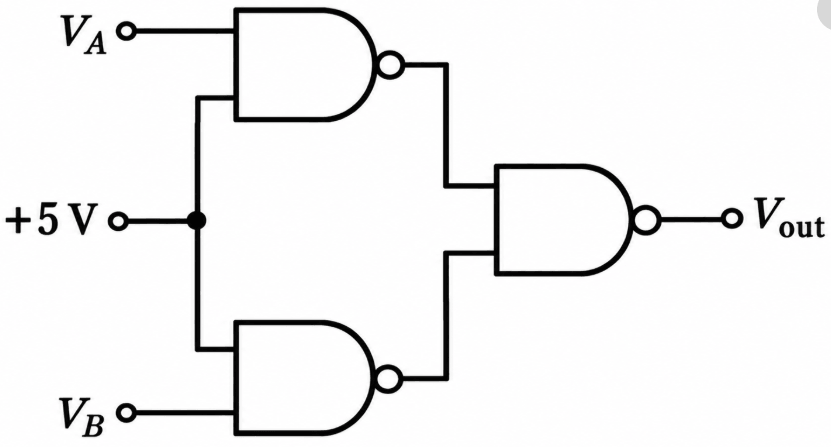 (2.5+2.5)